

Four reasons more Victorian landscapers are specifying retaining wall rock.
Natural retaining wall rock costs around 30 percent less than concrete sleeper systems and are installed in a fraction of the time. For walls under one and a half metres on residential and commercial jobs in Victoria, rock is the better call on cost, speed and sustainability.
Concrete sleepers have been the go-to retaining wall product on residential landscaping projects for years. More landscapers, designers and contractors are now coming back to natural rock. Four reasons stand out.
1. Retaining wall rock is around 30 percent cheaper
A natural landscape rock wall comes down to three component costs: the operator, the machine and the raw material. A concrete sleeper wall stacks up sleepers, steel posts, concrete footings, agi drainage, scoria backfill and the labour to coordinate the build. Across most residential projects, that adds up to roughly 30 percent more spend per linear metre than landscape rock equivalent.
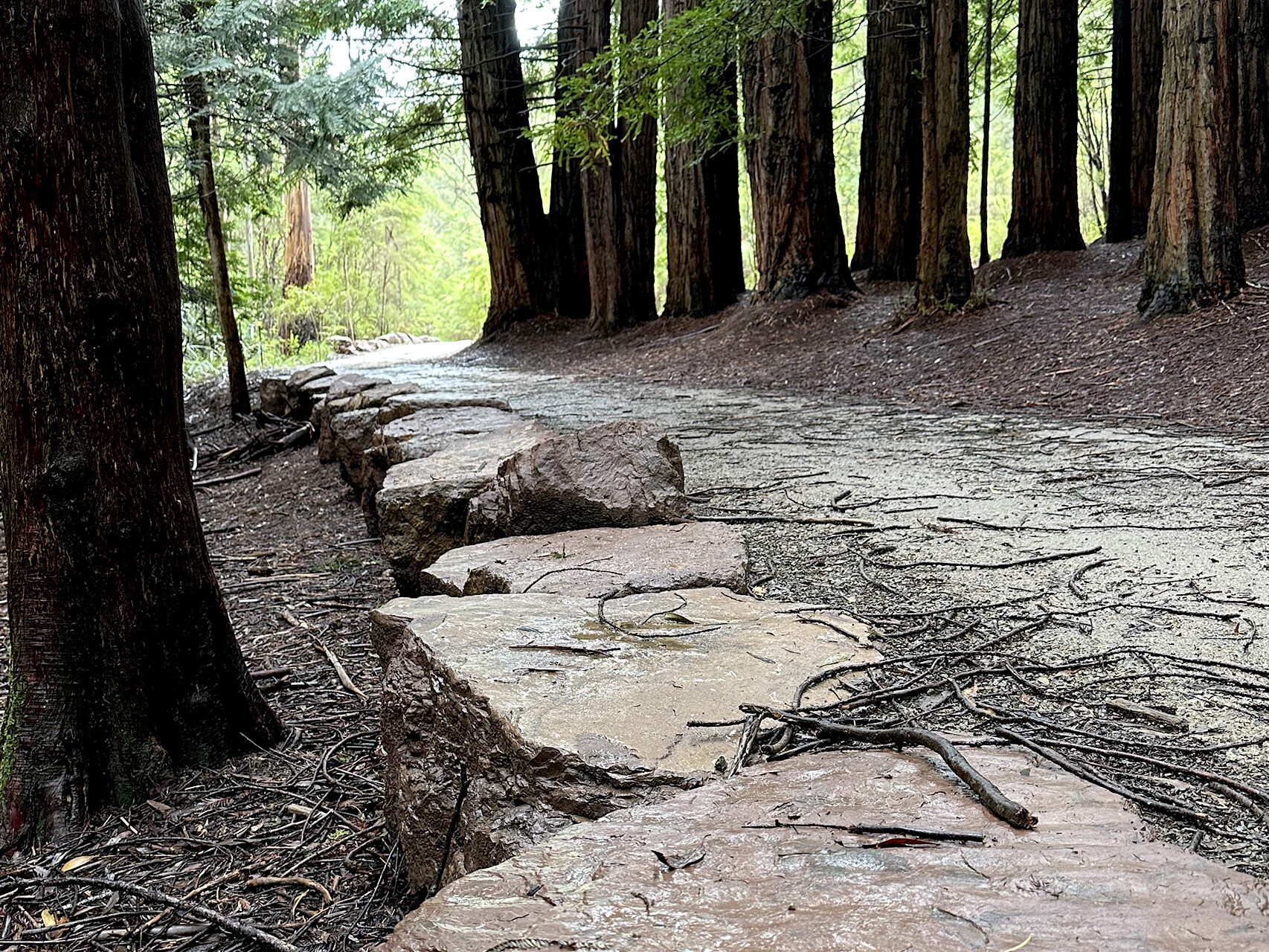
2. Landscape rock looks like it belongs
Concrete sleepers are a manufactured product and they look manufactured. Over time they fade, stain and show their age. Natural rock integrates into the landscape immediately and gets better as it weathers. The colour range available through Transrock is also broader than most realise. Soft beige and greige tones; warm greys and charcoals; and deeper, blue-toned stone plus plenty of options in-between. That gives designers the flexibility to match planting, architecture and paving on the landscape project.
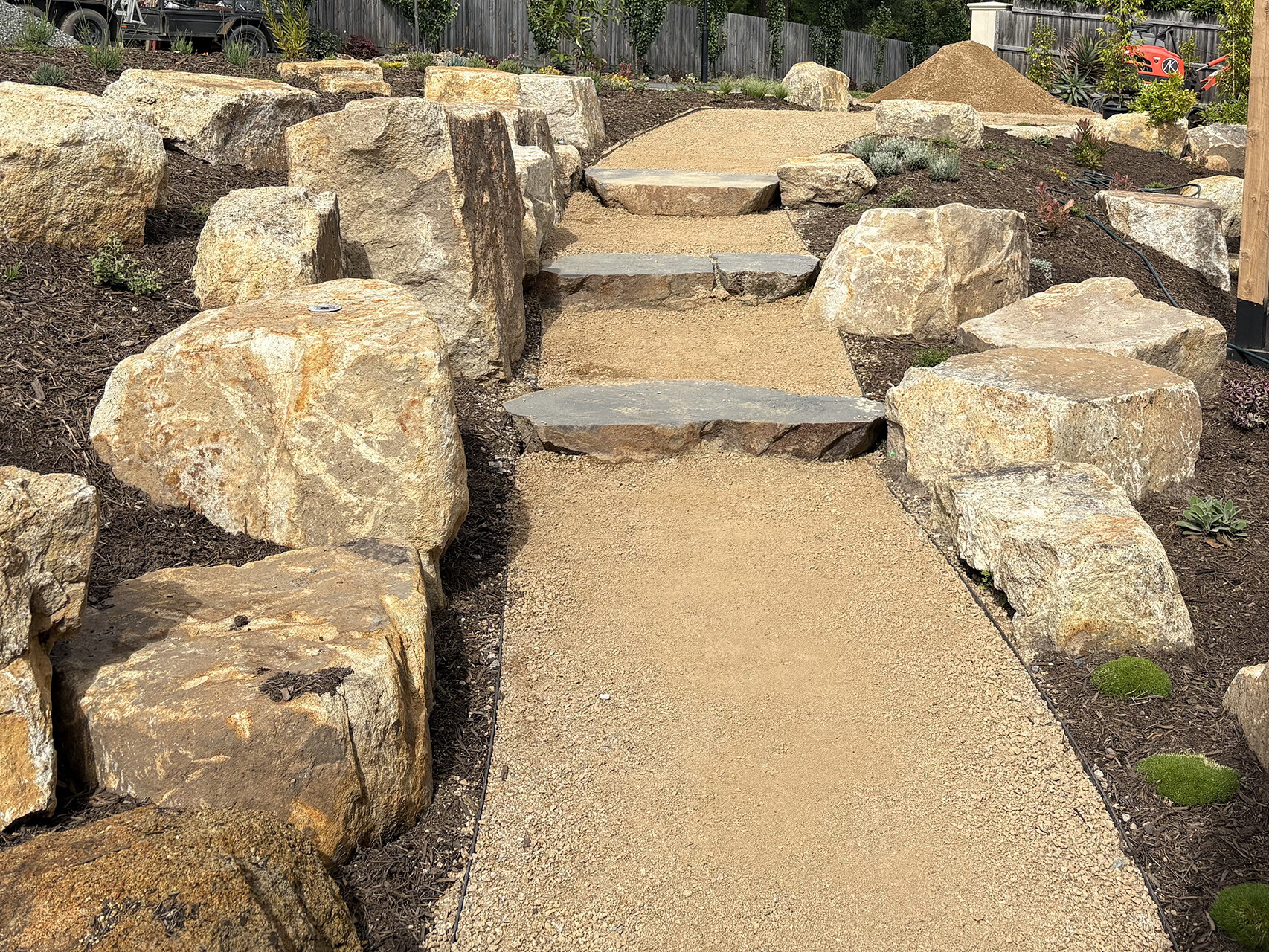
3. Retaining wall rock is faster to build
The bigger difference is time on site. A concrete sleeper wall is a multi-day job – digging post holes; hiring additional machinery to set foundations; pouring concrete; waiting on cure times; then setting levels and sleepers. A natural, retaining rock wall is a gravity wall. The weight of the rock holds it in place. With a competent operator and a small excavator, several metres of rock wall can be placed in a single day. Drainage looks after itself in most cases because water moves through the natural gaps between the rocks.
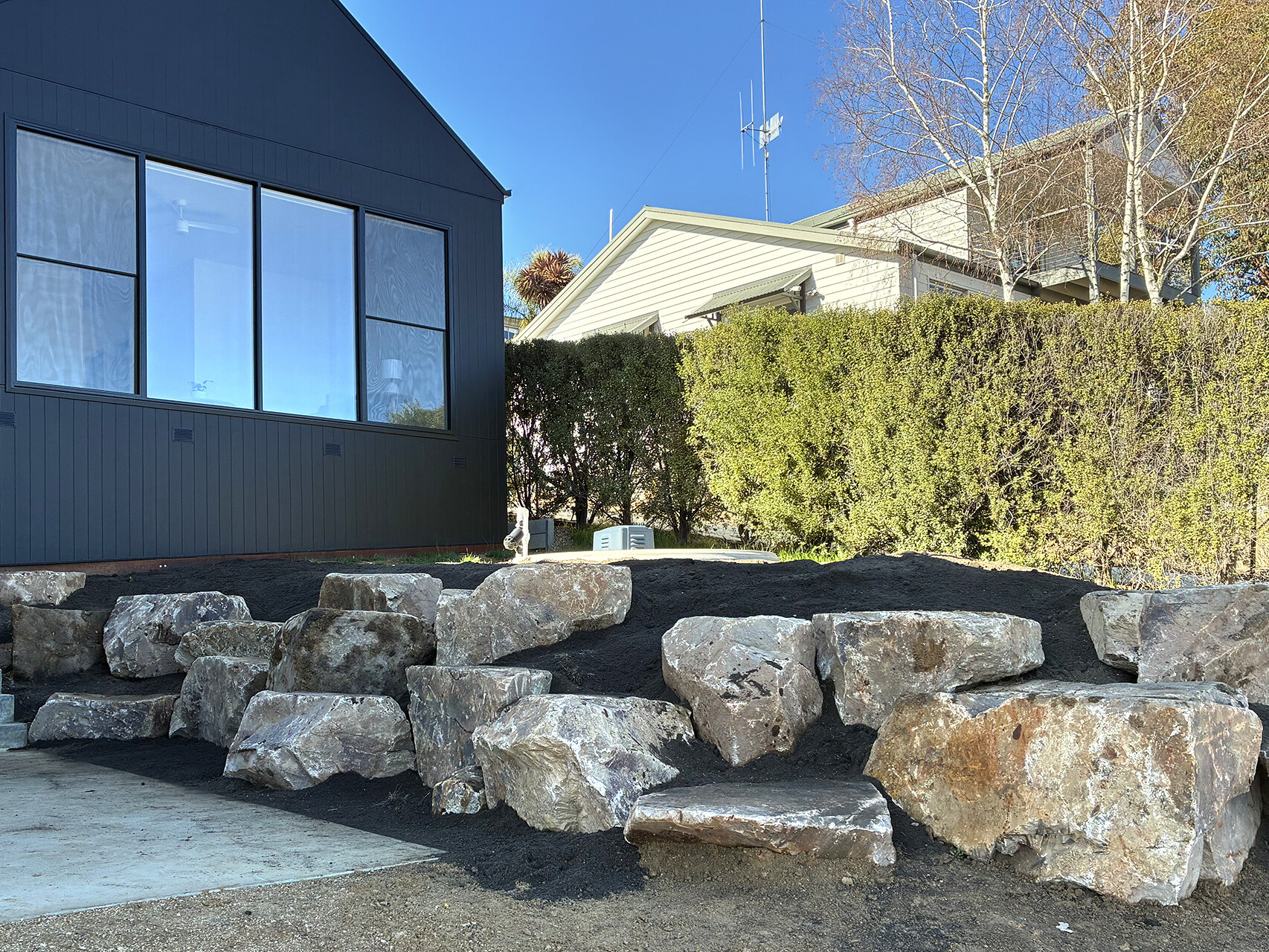
4. Retaining wall rock is the greener choice
Concrete sleeper systems carry significant embodied carbon from cement production, steel post manufacture and the transport behind both. Natural landscape rock is quarried locally in Victoria, minimally processed and much lower-carbon by comparison. At the end of a wall’s life the rock returns to landscape use rather than into a waste stream. That matters more on landscape projects where sustainability credentials are part of the brief.
Landscape rock range
Transrock supplies the full spread of landscape rocks for retaining walls. Smaller stacking rock for low garden edges; mid-sized hand-set stone for residential walls up to a metre; and larger feature boulders for civil and feature applications. Tell us the wall height, the colour palette and the look you are after and we will match size and quantity to suit.
Ready to rock?
Contact our expert team on (03) 9722 0920 for sizing advice and a quote that includes delivery. Drop into our Wonga Park display yard, in Melbourne’s outer east, to see our full retaining wall rock range in person. Or email your project details » click here
Frequently Asked Questions (FAQs)
Are retaining wall rocks cheaper than concrete sleepers?
Yes. Across most residential projects in Victoria, a natural retaining rock wall costs around 30% less per linear metre than a concrete sleeper system once you factor in sleepers, steel posts, concrete footings, drainage and the labour to coordinate the build.
How long does it take to build a retaining rock wall?
Much less time than a concrete sleeper wall. With a competent operator and a small excavator, several metres of rock wall can be placed in a single day. A concrete sleeper wall of the same length is typically a multi-day job. Post holes, footing pours, and cure times all add up before the sleepers go in.
What colours are available for retaining wall rock?
Transrock supplies natural retaining rock in colours ranging from soft beige and greige tones; through warm greys and charcoals; to deeper blue-toned stone with plenty of options in between. Most clients select to match planting, paving, or architectural materials on the project.
Do rock retaining walls need drainage or footings?
In most cases, no. Retaining wall rock is a gravity wall. Its own mass holds it in place. Water moves naturally through the gaps between the rocks, so a dedicated agi line is rarely required. Concrete sleeper walls, by contrast, almost always need both footings and drainage.
How tall can a rock retaining wall be?
It depends on engineering, soil conditions and your local council. As a general guide, most residential walls under 1 metre in Victoria can be built without formal engineering. Above that, engineering is typically required. Transrock supplies the feature boulders behind walls running well over 2 metres on civil and commercial projects across Victoria.
Where does Transrock deliver?
Transrock delivers across Victoria from its Wonga Park display yard in Melbourne’s outer east, covering Greater Melbourne, the Yarra Valley, the Mornington Peninsula and major regional centres.
What’s the difference between retaining wall rock and landscaping rock?
In practice they’re often used interchangeably. A landscaping rock and a retaining wall rock are usually the same product, just being used for a different job. The deciding factor is size relative to the wall height and the soil it needs to hold back. A rock that’s right for a low garden edge will be undersized for a metre-high retaining wall. Tell us the wall height and we will match the rock size to suit.