

Quick answer
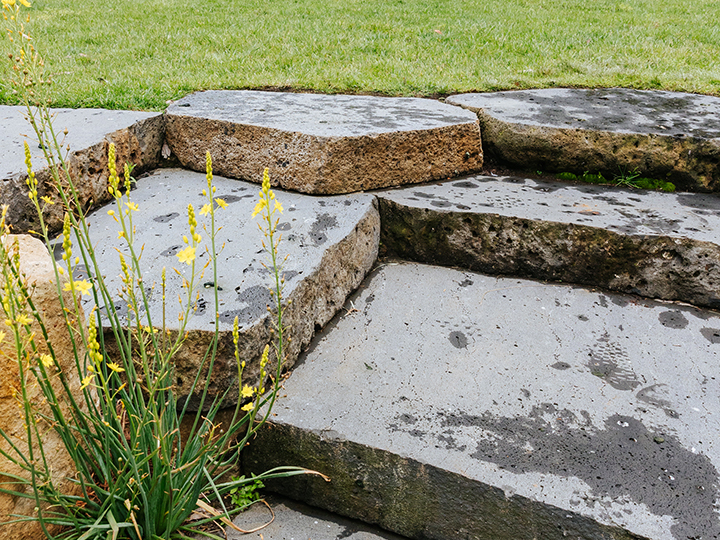
Sawn stone provides a stylish, sophisticated yet natural solution for steps, seats and steppers that look equally at home in a park, public space or residential garden.
The choice ultimately comes down to personal preference:
- Colour – Honey Granite is a light, warm greige; Basalt (bluestone) is a deep blue-grey.
- Edges and texture – Honey Granite is naturally rounder and softer-edged; Basalt is denser with crisper sawn edges.
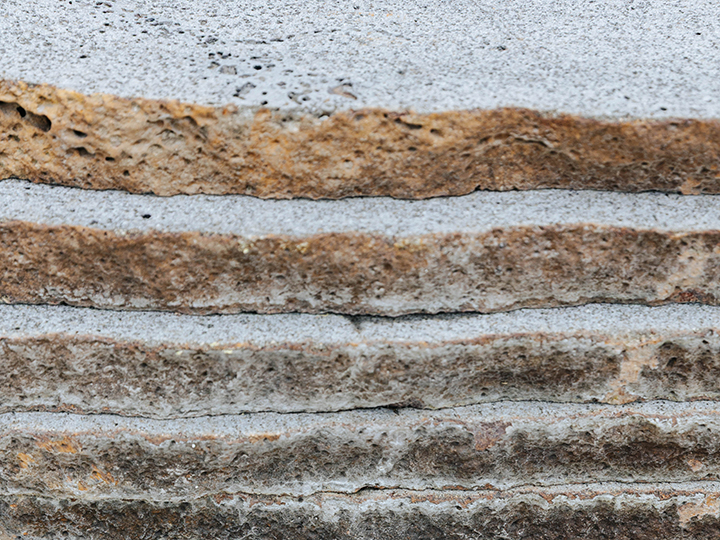
- Ageing – Honey Granite is slightly more porous, so freshly cut faces weather over the years to the honey tones seen on its outer edges; Basalt holds its colour for decades.
- Price – Honey Granite is slightly higher.
- Honey Granite suits green, native and soft contemporary gardens; Basalt suits formal, modern and civic settings. Both are available as 500 mm seats, 170 mm steps, and 30–35 mm pavers and steppers.
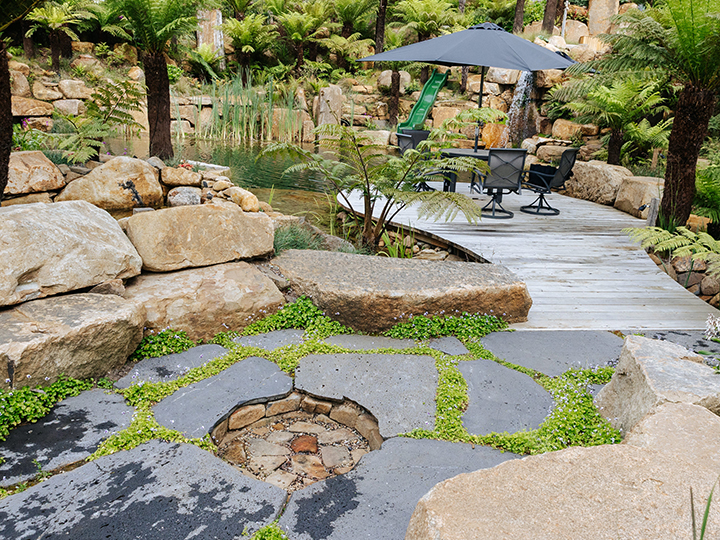
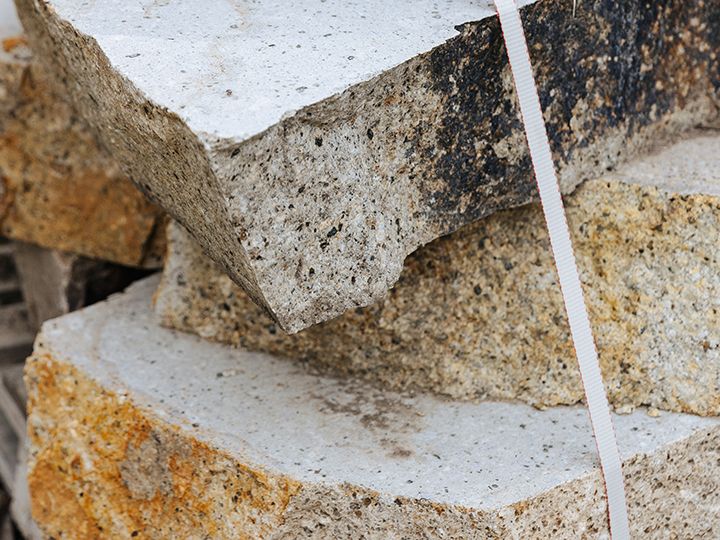
What is the difference between Honey Granite and Bluestone (Basalt)?
We’re often asked how to choose between Honey Granite and Bluestone (Basalt) sawn stone. All our sawn stone is sourced from Victoria, so they’ll both give a local feel that works well across a variety of garden styles.
The choice comes down to colour, how the stone ages and what it sits alongside. Both are cut to the same profiles and behave similarly underfoot.
Honey Granite steps, steppers and seats
- Locally-sourced and cut
- Greigy tones pair well with most colours
- Slightly more porous than Basalt, so the colour continues to change and evolve over time
- Can benefit from being sealed, however many customers choose to have this stone in a natural state
- Pairs well with Monument or similar darker shades
Basalt (Bluestone) steps, steppers and seats
- Locally-sourced and cut
- Pairs well with light colours
- Can benefit from being sealed, however many customers choose to have this stone in a natural state
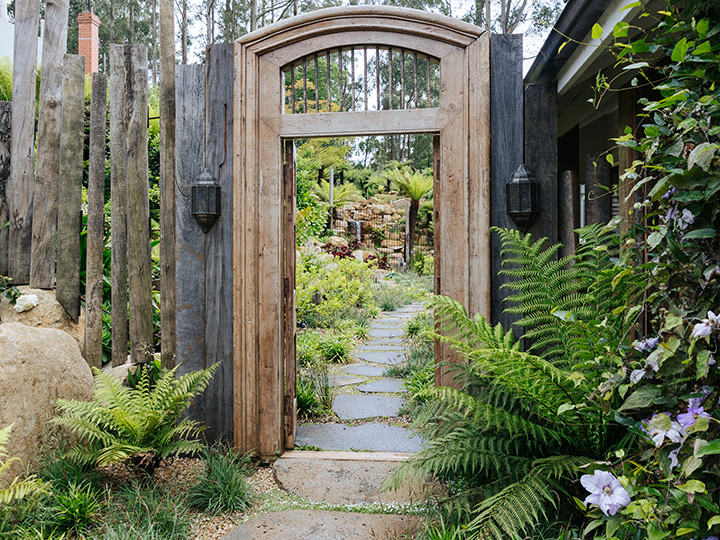
Side-by-side comparison
Feature | Honey Granite | Basalt (Bluestone) |
Colour | Light, warm greige – freshly cut faces start lighter and weather to honey tones | Deep blue-grey, quintessential Melbourne; some pieces show more 'cat's paw' pitting than others |
Texture and edges | Naturally rounded, softer-looking edges with tangible surface texture | Denser, tighter grain; crisper edges when sawn |
How it ages | Slightly more porous, so the colour keeps evolving. The cut face actively returns to the colourway on the outer edge | Very stable – holds its colour and finish for decades |
Staining and sealing | Honey Granite is a more porous stone, and depending on the environment, sealing might be suitable | Despite being less porous, Basalt can still benefit from sealing – depending on the environment the stone will sit in |
On-site cutting and modification | We recommend on-site cutting be done by a professional with appropriate PPE | We recommend on-site cutting be done by a professional with appropriate PPE |
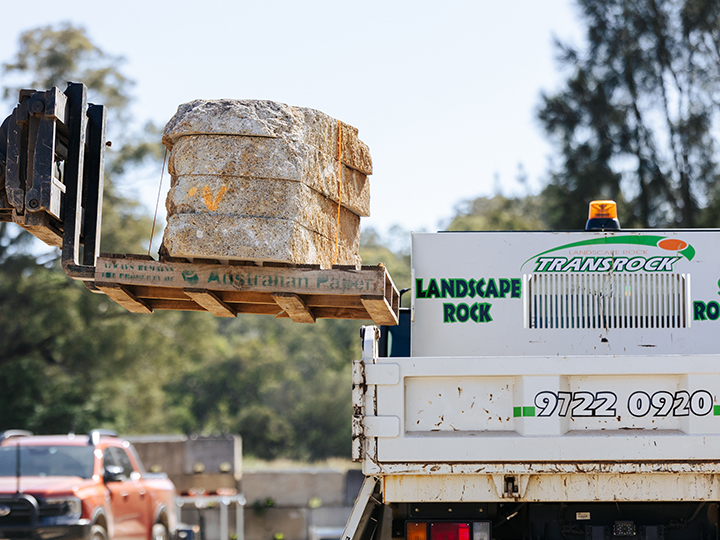
Weight (indicative) | An 800 mm wide seat can weigh around 1,000 kg on its own, with larger pieces heavier again | An 800 mm wide seat can weigh around 1,000 kg on its own, with larger pieces heavier again |
Standard profiles | 500 mm seats 170 mm steps 35 mm pavers and steppers | 500 mm seats 170 mm steps 30 mm pavers and steppers |
Price | Slightly higher | Slightly lower |
Pairs best with | Green planting, native gardens, darker coloured homes | Light-coloured homes and render, contemporary and formal designs |
Source | Victoria | Victoria |
Best suited to | Schools, native gardens, soft contemporary | Modern/formal homes, civic and heritage settings |
Frequently Asked Questions (FAQs)
Yes – Bluestone is the common Australian name for Basalt. The name has stuck because it describes the colour of the rock well.
Honey Granite generally costs slightly more than Bluestone, although a large share of the price of any sawn stone is the labour and machinery needed to cut it, so the difference is usually modest.
Some of our customers have taken seats and cut birdbaths in, or had cores drilled into stone pieces to allow for water flow. We recommend working with a professional stone cutter to achieve your desired result. Ask the team and we can point you in the direction of someone who might be able to help.
Next step
Not sure which way to go? We can help. Bring a sample of your paving, render or decking to the Wonga Park display yard and compare it against both stones – it usually settles the question in a few minutes. Or email us a photo of the site and we’ll give you our expert opinion on which will suit. » click here